
.png)
The behavioral health market is in the midst of a real transformation. Teletherapy is now mainstream. MSOs are making therapists more accessible than ever, and insurers are covering mental health services more “generously” than they used to in previous decades.
But behind that growth is a data landscape that's genuinely hard to read; reimbursement rates vary widely by payer, region, and provider, and referral patterns are often invisible. At Serif Health, we spend our time making that landscape legible and actionable.
Two pieces matter most:
- Understanding where patients actually go for care
- Understanding what providers actually get paid for it.
Following the Patient Journey
A great reimbursement rate doesn't mean much if patients never show up. That's the starting point for referral analytics which is especially critical to behavioral health providers seeking to get new patients.
Using claims data, we can trace a patient's full journey: from the referring visit all the way to the behavioral health service they eventually receive. This data turns a vague, gut-level sense of "where our patients go" or “might go instead of our clinic,” into an observed, data-backed map of care.
Each referral event we track carries important details on both sides. That includes the organizational NPI and the individual physician for both the referring and receiving provider, the referring specialty, the procedure and diagnosis codes involved, the payer at each point in the chain, and how many days pass between the referral and the delivered service.
Aggregated across a market, that information answers questions that are simple to ask but historically very hard to source like:
- Which organizations are capturing most of a given referrer's outbound volume?
- Where is volume leaking out of a network entirely?
- How long does it typically take a referral to convert into an actual visit?
Seeing the Provider Perspective
Think about a specialty behavioral health provider treating a specific condition. They want to know which primary care or pediatric practices in their area are diagnosing patients they could treat, whether those referrals are reaching them, and how their capture rate compares to competing providers.
Referral analytics can show a provider that they're getting a meaningful share of a given practice's cases, while a competitor down the street is getting more. From there, the data can be filtered down to the individual referring physician, so the provider knows exactly where to focus their outreach.
Health systems use the same data from the opposite direction, often called leakage analysis: tracking whether their own patients are staying within their network for downstream care, or drifting to a competing system instead.
Because the useful version of this question is always narrower than a market-wide view, we deliver it as an interactive dashboard alongside the raw data. Filters across metro area, payer class, specific payer, referring specialty, and referral latency let a market access team isolate something as specific as commercial referrals from primary care in a single metro, converting to a specialist visit within thirty days, and immediately see which organizations captured that volume.
What the Really Rates Say
Referral patterns tell you where patients go and reimbursement data tells you what that's worth. This nuance is especially important in behavioral health reimbursement is more complicated than it looks at first glance.
Take CPT code 90837, a 60-minute psychotherapy session and the most commonly billed code for behavioral health visits. A critical wrinkle is licensure: a PhD-level clinician's rate is typically different from a Master's-level clinician's rate for the exact same code, and payers don't always make that distinction easy to find.
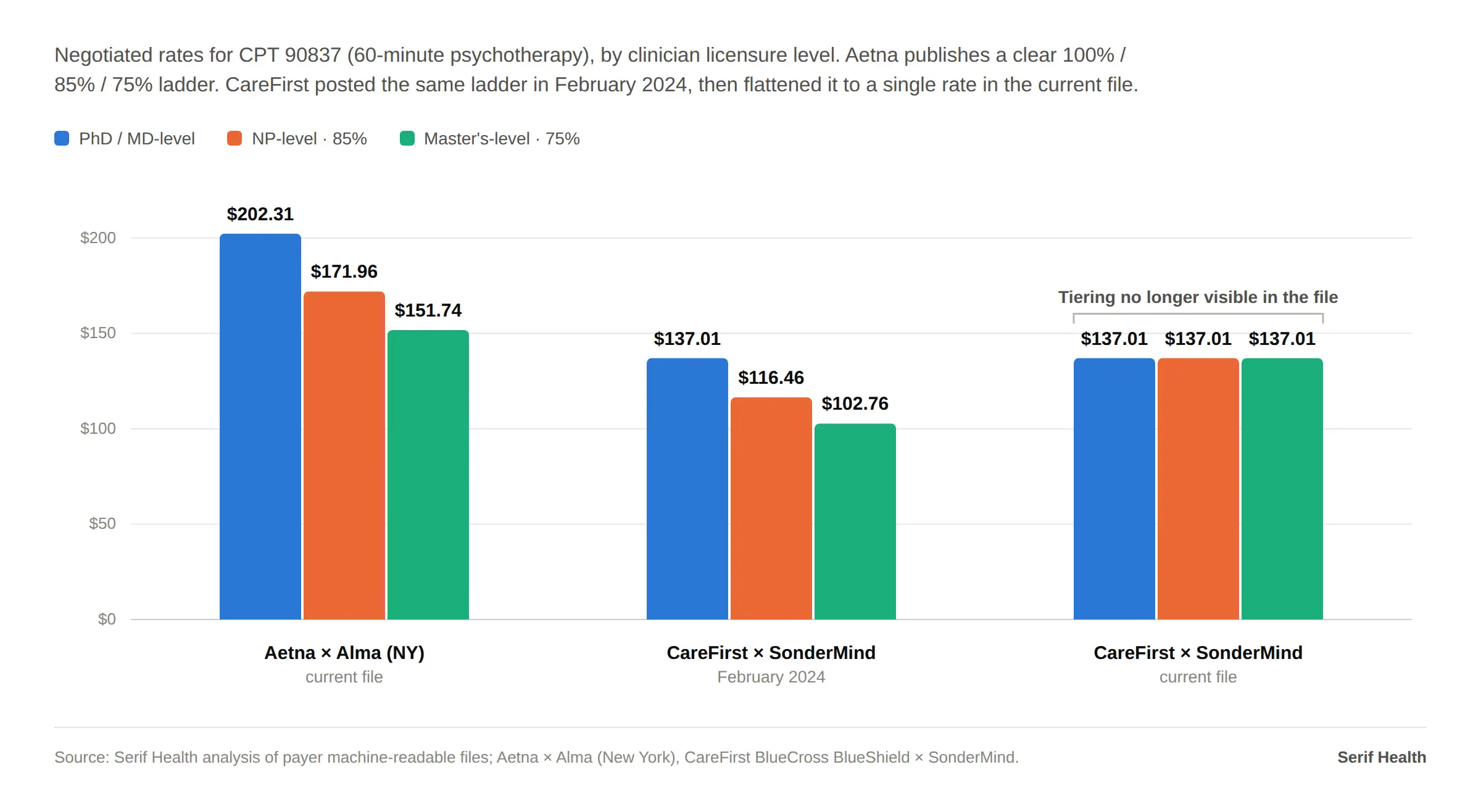
For example, a search for Aetna's negotiated 90837 rate with the MSO Alma in New York returns over 750 rows of data. Filtering to the rates with the largest affiliated NPI lists narrows that down to just four rows, all covering the same clinicians. Knowing Aetna's standard rate ladder, that NP-level rates run 85% of the PhD rate and Master's-level rates run 75%, the four rows resolve into a clear tiered structure: $202.31 for PhD/MD-level clinicians, $171.96 for NPs, and $151.74 for Master's-level clinicians.
CareFirst BlueCross BlueShield's rates with the MSO Sondermind look flatter at first: the same $137.01 rate seems to apply across licensure and taxonomy in the current file. But checking historical postings tells a different story. Back in February 2024, CareFirst posted the same $137.01 rate with visible tiering: $116.46 for NPs and $102.76 for Master's-level clinicians, the same 85%/75% structure as Aetna. The tiering didn't disappear from the market; it disappeared from the file.
That's the kind of pattern that only shows up with historical tracking, payer-specific knowledge, and a lot of attention to detail.
Why This Matters Now
Behavioral health MSO networks are growing fast. Distinct NPIs across major MSOs are up over 57% in the past year, with 22% of that growth happening year-to-date alone, and roughly a third of clinicians are now credentialed with more than one MSO at a time. As the market gets more competitive, both referral capture and rate benchmarking become even more important, not less.
Accurate data here supports better contract negotiations, smarter benefit design, and stronger provider recruitment. Price transparency and referral data give a real window into these dynamics, but only when someone takes the time to validate, interpret, and connect the two.
That's the work we do at Serif Health, so behavioral health organizations can make data-driven decisions. To learn more, contact our team with this link here.