
.webp)
Price transparency promised a lot. Starting in 2021, federal rules required hospitals to publish their negotiated rates in machine-readable files (MRFs). Starting in 2022, federal rules also required payer data to be released. For the first time, the data that had always existed behind closed doors was out in the open. It felt like a turning point, the moment healthcare pricing would finally make sense.
Except the files arrived, and it didn’t get that much easier.
The hospital data was messy, inconsistent and lacked standardization. The payer data came with more challenges. It was massive, full of noises riddled with errors. Key fields were missing. Code types didn’t align. Rates that looked usable turned out to be ghosts, listed but never actually paid. Teams with real questions (What does an MRI cost in our market? How do our rates compare to peers? ) still couldn’t get to answers without weeks of work and significant technical expertise.
This is the problem Serif Health was built to solve.
We’ve Always Believed the Goal Is the Answer, Not the Data
When Serif Health launched Signal in 2023, the north star was simple: Take the raw complexity of price transparency, the hundreds of payers, the thousands of hospitals, the billions of rate records processed every month, and turn it into a platform that a contracting team, a benefits director, or a CFO could actually use.
Over the past three years, more than 250 organizations have relied on Signal to benchmark rates, evaluate networks, and understand market dynamics. That experience has shaped a deep understanding of what questions teams are really asking, where the friction lives, and how much faster the work could move if the path from question to answer were clearer.
That learning is what’s behind our new look and focus.
A New Look. A Sharper Mission.
Last month, Serif Health launched a redesigned brand and website to reflect not just who we are, but where we’re going.
The new homepage opens with six words: Healthcare is Complex. Pricing Shouldn’t Be. That’s not just marketing language. It’s an operating principle. Healthcare doesn’t lack data anymore. It lacks clarity. Our job—the thing the team spends every day working on—is closing the gap between the question someone has and the moment they can act confidently on the answer.
The new website makes that mission tangible. It’s organized around the decisions customers are actually making: benchmarking and negotiating rates, evaluating networks, understanding market dynamics, forecasting spend. Whether you’re a managed care team preparing for a payer negotiation, an employer designing benefits, or a life sciences company modeling reimbursement for a new therapy, you’ll find a clearer path to how Serif Health can help.
A Platform Built Around How You Think, Not How Data Is Structured
Alongside the rebrand, Serif Health has made meaningful upgrades to Signal itself. The platform now guides users toward the right analysis automatically, rather than asking them to choose between reporting modes or manually configure their approach. You start with what you want to know. Signal handles the rest, pulling together payer, hospital, and claims data in a single workflow.
Guided Starter Kits have also been introduced for the most common pricing analyses, so teams new to price transparency can get to meaningful results faster, and experienced analysts can move even more efficiently.
Serif is also previewing Signal Ask—an AI-powered research capability engineered specifically for the complexity of healthcare pricing. Signal Ask allows users to query pricing data in plain language, without needing to know billing codes, data structures, or which dataset to search. It’s the first step in a broader AI roadmap, and it reflects the same belief that has driven the company from the beginning: the expertise should live in the tool, not be required of the user.
The Foundation Hasn’t Changed
What powers all of this is data infrastructure that most vendors don’t attempt to build. Serif normalizes data across 200+ commercial payers and 5,000+ hospitals, validates it against billions of commercial claims, and structures it before it ever reaches a user.
That means cleaning out the rates that look real but aren’t, standardizing inconsistent formats, mapping provider and payer relationships, and benchmarking everything against Medicare for context. Nearly three years of longitudinal rate history means customers can track trends, not just point-in-time snapshots.
Good answers require good data. That part doesn’t change.
This Is What Progress Looks Like
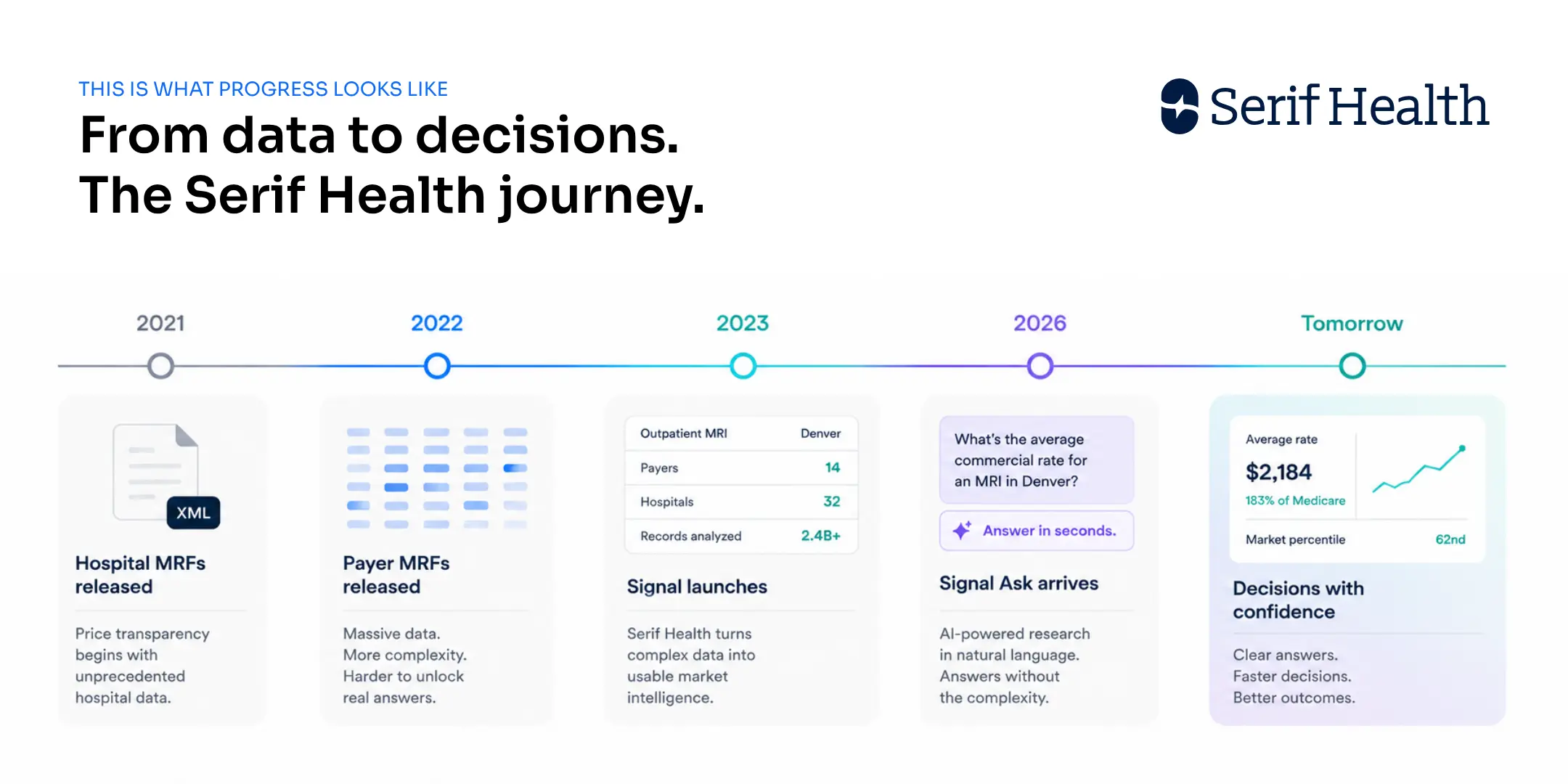
Price transparency started as a policy change. Then it became a data problem. Now the challenge is something more human: how do you help people who have real questions get to clear answers, as fast as possible?
That’s the question driving Serif Health’s next chapter. We’re proud of how far the industry has come, and clear-eyed about how much further there is to go. The new brand and platform are Serif Health’s way of showing up to that work with everything the team has built and everything it has learned.
We’d love for you to see it. Explore the new Serif Health at serifhealth.com, try Signal with your first question, or book time with the team to talk through what you’re working on.
The answer is closer than you think.