

There is an all too familiar pattern that plays out in health system contracting teams across the country. A payer contract comes up for renewal. The team scrambles to pull data, build a rate comparison, and construct an argument for better terms. Once the deal gets done, the cycle resets until the contract is up for renewal again.
That approach is not wrong, and it was all that was possible until recently. But today, the organizations gaining a real edge in payer negotiations are not only preparing better and faster at renewal time, they are also building market intelligence that compounds between contract cycles.
By the time they sit down with a payer, they already know what the market has been doing for the past twelve months. Price transparency data makes this possible. The shift is more straightforward to implement than most teams expect.
The Problem With Snapshot-Only Analysis
Most contracting teams rely on point-in-time data pulls. They benchmark rates at or near renewal, build their position around what the market looks like in that moment, then move on. This approach has a fundamental limitation: it captures the market at a single point in time.
The reality is that markets move. Payers update their machine-readable files monthly. Competitor rates shift. Contract structures change. A payer that tightened rates across a market six months ago is a different negotiating partner than one that has been granting increases. A snapshot taken at renewal does not tell that story – and that story matters.
The teams that track the market between contract cycles negotiate from a position of accumulated knowledge that a pre-renewal scramble cannot replicate.
What Continuous Intelligence Actually Looks Like
Building a continuous intelligence function does not require a large investment or a dedicated analytics team. It requires three things: regular data refreshes, a process for monitoring key codes and competitors, and internal ownership of the insights.
Regular data refreshes mean working with MRF data that is updated on a monthly cycle. Each monthly update is a new data point. Over time, those data points reveal patterns: which payers are tightening rates in a given market, which competitors are gaining rate position, which service lines are seeing the most movement.
Monitoring key codes means focusing attention on the 25 to 50 high-spend codes that drive the most negotiation value. Tracking everything is neither practical nor necessary but tracking the codes that matter most is both, especially with the right data and tools.
Internal ownership means someone is accountable for reviewing the data on a recurring cadence and translating it into negotiation-relevant insights. Without ownership, even good data tends to sit unused.
A Concrete Example: What a Year of Market Data Reveals
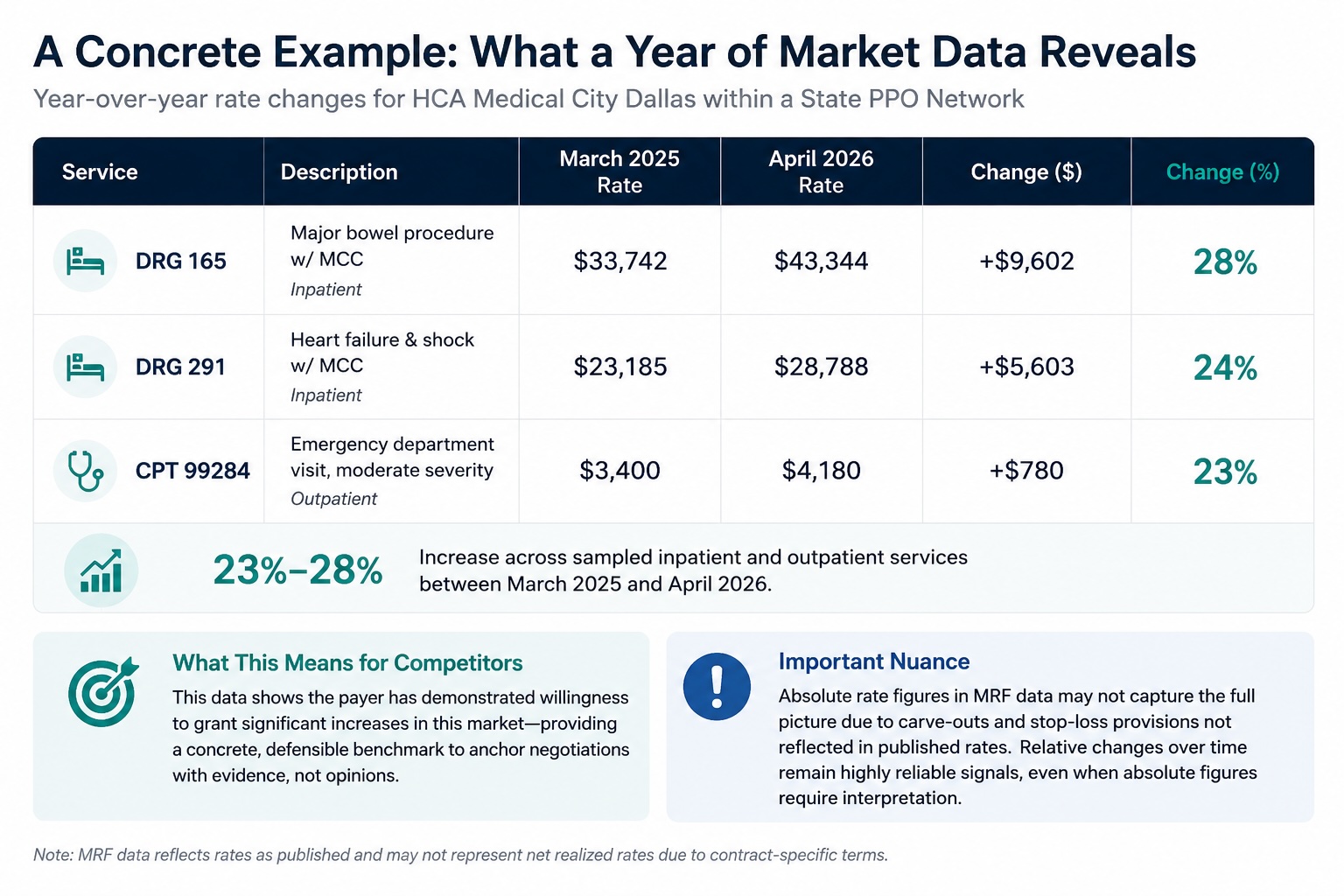
Reviewing year-over-year tracking of HCA's Medical City Dallas within a State PPO network reveals the value of ongoing analysis. Price transparency data confirmed rate increases of 23 to 28% across sampled inpatient and outpatient services between March 2025 and April 2026. DRG 165 moved from $33,742 to $43,344, a 28% increase. DRG 291 moved from $23,185 to $28,788, a 24% increase. CPT 99284 moved from $3,400 to $4,180, a 23% increase.
For a competing health system preparing its own negotiation with that same payer, this data establishes that the payer has demonstrated willingness to grant significant increases in this market. It provides a concrete, defensible benchmark to anchor the conversation. It is the difference between walking into a negotiation with opinions or walking in with evidence.
One important nuance: absolute rate figures in MRF data do not always capture the full picture. Contracts may include carve-outs and stop-loss provisions not fully reflected in published rates. Relative changes over time remain highly reliable signals, even when absolute figures require interpretation. A directional increase of this magnitude is meaningful whether or not the underlying rates reflect every contract detail.
What This Means for Contracting and Finance Teams
For contracting leaders, continuous market intelligence changes the nature of negotiation preparation. Instead of building a position from scratch at renewal, teams can enter every negotiation with months of accumulated context: where payer behavior has shifted, what competitors have achieved, which service lines represent the strongest opportunity for improvement.
For finance and strategy leaders, the value is in the planning cycle. Revenue forecasting and budget modeling become more grounded when informed by actual market rate trends rather than assumptions. Contracts where reimbursement may be drifting below sustainable levels become visible earlier, before renewal pressure forces a reactive response.
Price transparency data will never replace negotiating skills or relationships. However, the data gives teams the market knowledge to use those skills more effectively, with greater confidence, at every stage of the contract cycle.
The Competitive Advantage Compounds Over Time
Market intelligence can no longer be viewed as a one-time asset because intelligence compounds. A team that has been tracking competitor rates and payer behavior for twelve months enters a negotiation in a fundamentally stronger position than one that pulled a snapshot two weeks before the meeting.
The organizations that recognize this are not waiting for renewal cycles to start building their position. They are building it continuously, every month, with every MRF update. These are the organizations with the real competitive advantage.
Serif Health can run a targeted benchmarking analysis across your top service lines, typically within days, using real market data. Download How Health System Executives Are Using Price Transparency Data to Benchmark, Negotiate, and Grow or get in touch to learn more.