
.webp)
What the Market Is Already Telling You About Where to Grow
For most health system executives, growth decisions have always carried some degree of uncertainty. Determining whether to enter a new market, launch a service line, or invest in a new setting of care required assembling fragmented estimates, relying on consultants, and making assumptions that were difficult to validate before significant capital was committed.
That dynamic has shifted. Price transparency mandates now require payers to publish negotiated commercial reimbursement rates through machine-readable files (MRFs). For health system strategy and business development teams, this is a meaningful change in a positive direction.
The market intelligence that once required months of engagement to assemble is now, with the right tools, available in days.
The question is whether health systems are using it.
Growth Decisions Deserve Better Inputs
The traditional approach to evaluating a new market or service line looks something like this: survey comparable markets, model revenue based on internal assumptions, consult with advisors, and hope the underlying data is close enough.
The problem is not the process itself. The problem is that the inputs have historically been too thin, too slow, and too disconnected from what the market is actually paying.
Price transparency data changes that calculus. When MRF data is properly cleaned, normalized, and enriched, health systems can answer questions that previously had no reliable answer:
- What are commercial payers reimbursing for a specific service in a target market?
- How does the reimbursement landscape compare across multiple markets under consideration?
- Where do competing providers sit relative to Medicare benchmarks in that geography?
- What is the payer concentration in the market, and how does that affect negotiating position?
These answers represent much more than marginal refinements to the planning process. They are the critical foundational inputs that reduce guesswork and sharpen the business case—all before capital decisions are made.
A Smarter Framework for Market Evaluation
Consider a health system evaluating three potential markets for a new ambulatory surgery center. Historically, the comparison would rely on demographic data, utilization estimates, and anecdotal intelligence from market participants. Today, the same analysis can be grounded in actual reimbursement data.
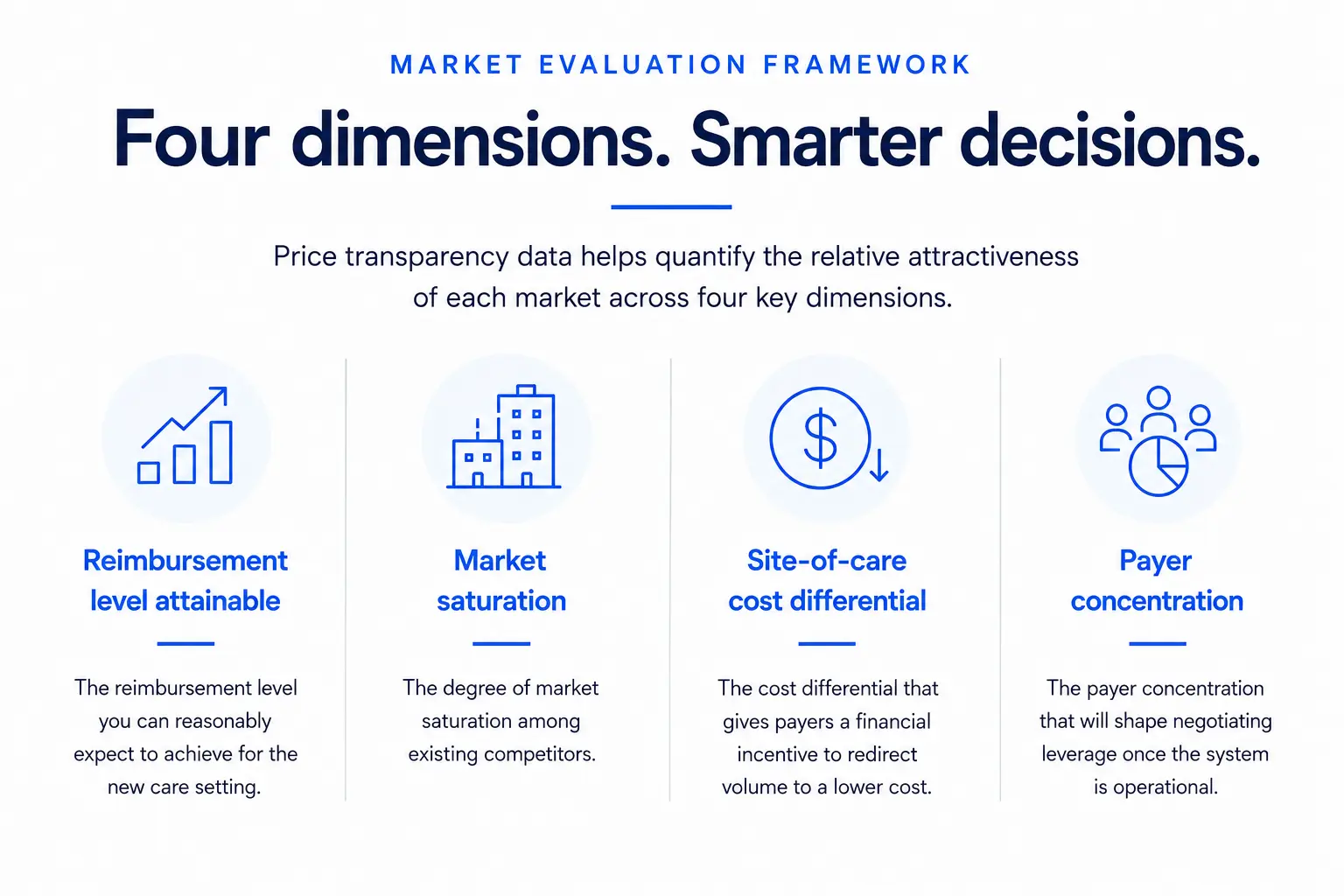
Across four dimensions, price transparency data can help quantify the relative attractiveness of each market:
- The reimbursement level attainable for the new care setting
- The degree of market saturation among existing competitors
- A site-of-care cost differential that gives payers a financial incentive to redirect volume to a lower cost
- The payer concentration that will shape negotiating leverage once the system is operational.
This kind of structured comparison does not replace judgment but it does replace guesswork with evidence, which is a significant upgrade for any growth decision.
Service Line Planning Benefits Too
The same logic applies when evaluating whether to add a new clinical service. Before negotiating rates with payers to support a new offering, strategy teams can use MRF data to map the current reimbursement landscape for the relevant procedure codes.
Understanding where the market pays, at what percentile comparable providers are positioned, and how wide the spread is between top and bottom performers gives the contracting team a far stronger foundation heading into those conversations.
The result is a more defensible business case, a more credible negotiating position, and a clearer picture of realistic revenue expectations, all before a single dollar of capital has been deployed.
The Competitive Advantage Is in the Application
The reality is the price transparency data does not create a strategic advantage simply by existing. The advantage accrues to health systems that invest in the infrastructure and expertise to make that data usable—and actually use it.
Turning raw MRF files into reliable market intelligence requires ingestion at scale, normalization across code sets, claims-driven filtering to eliminate phantom rates, and enrichment with provider and geographic context.
Health systems that build or partner for this capability are gaining something their competitors may not yet have: the ability to evaluate opportunities with precision, move faster on the right ones, and avoid costly commitments in markets where the economics do not support them.
The inputs are now available. The competitive advantage comes from knowing how to use them.
Ready to see what the market is telling you about your next growth opportunity? Download the full Health System Executive Guide to learn how leading health systems are using price transparency data to plan smarter, negotiate stronger, and grow with confidence.
Want to learn more about how Serif powers growth assessments? Get in touch with our team today!