
.png)
Nearly 2 billion rows of price transparency data carry the wrong billing class.
Institutional and professional rates are structured and priced differently. Institutional rates cover the facility, meaning the operating room, staff, and equipment. Professional rates cover the physician who performs the procedure. Most teams working with the data reasonably assume the label in the file is accurate.
That is not always the case. Payers sometimes publish facility rates under a professional label.
What then follows is that every rate comparison or aggregate report built downstream from the data inherits the error. Essentially, the price of the operating room gets filed as the price of the surgeon. It is an easy issue to overlook and a consequential one as finding these rates by hand across billions of rows is close to impossible.
Before we get to how Serif corrects for this, here is what the impact looks like.
What Mislabelling Looks Like in the Data
Aetna's August 2026 Open Access Managed Choice file offers a clear example. Across a basket of five common outpatient procedures, Serif reclassified more than 180,000 rates that the payer had published as professional. These rates were billed by ambulatory surgery centers and other facilities rather than by physicians, and each one exceeds what Medicare pays a facility for the same procedure.
In one such example, Aetna published a professional cataract removal with an intraocular lens rate of $3,743. This Aetna file’s professional median for that code in the same network is $659. Because the rate was billed by a facility, it belongs with facility rates. Under a professional label, it lands in the physician pool at 5.7 times the going rate.
The same pattern holds across the other procedures:
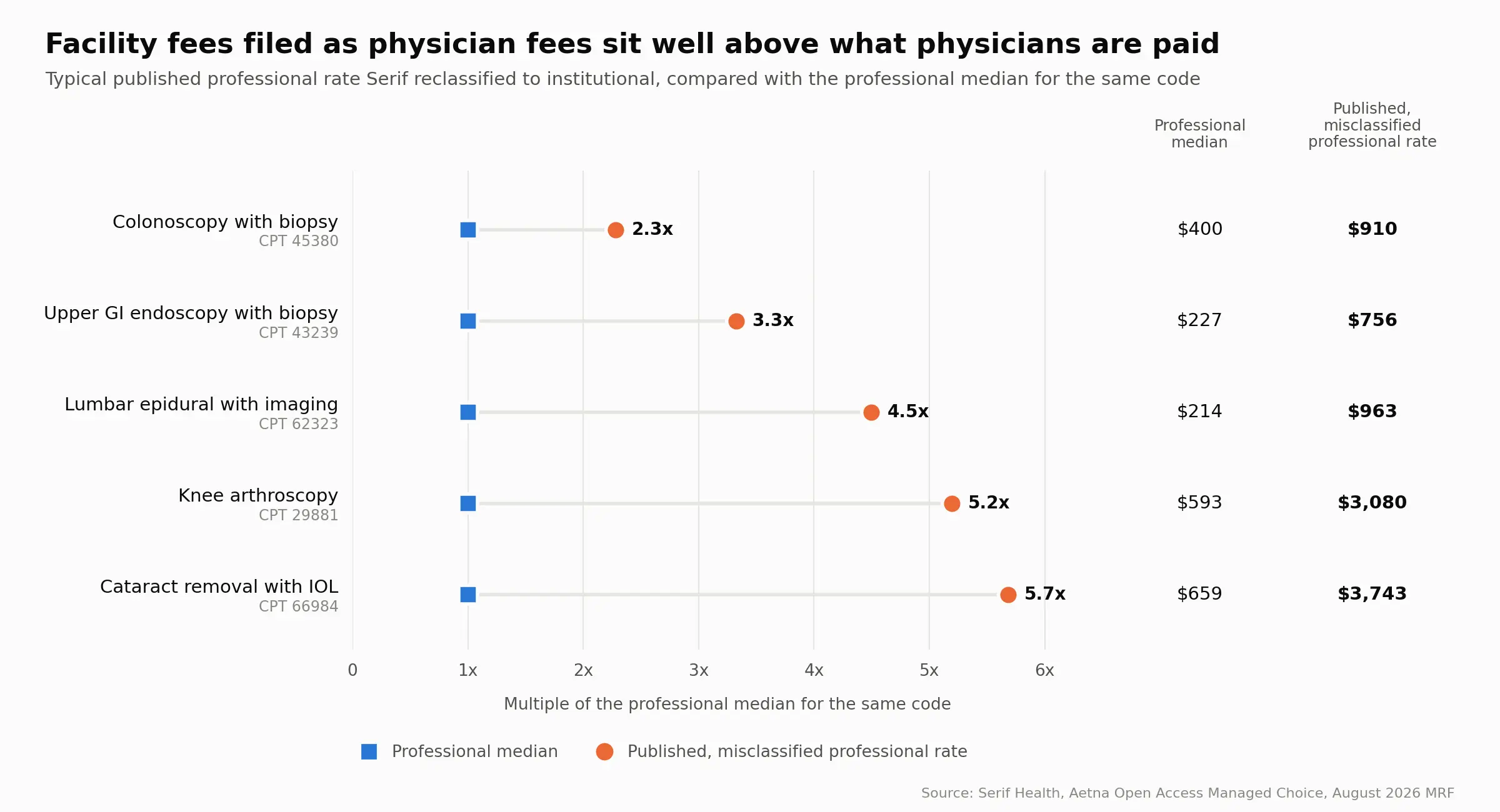
The professional medians come from other professional rates in the same Aetna network, so the comparison is internal to Aetna's own pricing. Differences in how Aetna pays compared with other payers don't affect it. In each case, the misclassified rate sits between 2.3 and 5.7 times what physicians are paid for the same code and would have inflated any benchmark report.
Taking a look beyond our basket of codes, the correction touched a total of 3,798 procedure codes which includes more than 22 million rates across this one network. Left in place, those misclassified rates would be raising the average professional rate by about a third. The effect is concentrated in surgical care, led by digestive procedures at 46%, while radiology and lab services are almost untouched.
Why These Rates Are So Hard to Catch
Most data quality checks look at the rate itself but the rate alone rarely gives these rows away. A $910 colonoscopy is certainly a plausible number. However, there’s two things that sit outside the rate column that identify it as a facility fee: who billed it and how the rate compares to what Medicare pays the facility and the physician for the same code. Without that context, a misclassified rate could look like any other row in the file.
The broader scope only adds to the narrative. Across the full corpus of 1.66 trillion rows within all of price transparency, misclassified billing class accounts for 0.12%. The share is small, and it is also effectively invisible from inside the file but we find that that's what makes these misclassified rates consequential.
Once an analyst finds a handful of rates that do not belong, the reasonable response is to question the rest. That doubt spreads past the affected rows to the other 99.88% of the data, which was correct all along, and to every benchmark built from it. Confidence in a dataset accumulates slowly and erodes quickly. A single figure that cannot be defended in a renewal conversation changes how every other figure in the analysis is received.
How Serif Corrects For It
Serif's correction combines the payer's file with provider type data and Medicare reference rates. It focuses on the procedures where the distinction matters most, which are codes where Medicare pays substantially more for the facility than for the physician. For those codes, a rate published as professional is reclassified as institutional only when the evidence lines up:
- The rate was billed by an ambulatory surgery center or another facility rather than an individual physician
- The rate exceeds what Medicare pays that type of facility for the same procedure.
Rates that do not meet those conditions keep the payer's original label.
Confidence In Every Row
Public MRFs were the first step toward price transparency. Making the data usable is a separate job. If you cannot assume that an ambulatory surgery center's rate is labeled as a facility fee, every downstream analysis has to account for the chance that it is not.
That is why Serif does this work before the data reaches you.
Billing class is one of several corrections we apply across our data, alongside phantom rate removal, custom code mapping, and negotiation type corrections. Each one exists for the same reason: price transparency data is only as useful as the confidence you can place in it.
To learn more about Serif's approach to data quality, download our Definitive Guide to Data Quality.
Want to see how Serif Health handles data quality in practice? Schedule a demo with our team with this link and find out what decision-ready price transparency data actually looks like.